One Day at a Time

MOOD: Grateful
CURRENT MUSIC: –
WEATHER: Clear
LOCATION: Own Home
TRIGGER WARNING: Yes

In June 2026, shortly after returning from Hajj, I found myself in hospital needing a blood transfusion after suffering severe blood loss. I had lost almost half of my body’s blood volume.

It turned out that the bleeding was caused by a fibroid growing on the wall of my uterus. Thankfully, there was only one, but it was quite large, measuring about six centimetres.

During my first admission, I was given an injection called Zoladex, a hormone treatment administered through a small implant placed under the skin. In simple terms, it temporarily suppresses oestrogen production, helping shrink fibroids and reduce heavy bleeding.

The injection I received was designed to last for three months.

The plan was to shrink the fibroid enough for me to undergo a minimally invasive procedure called a hysteroscopic myomectomy. Unlike conventional surgery, this procedure does not require any abdominal incisions. Instead, a specialised instrument is inserted through the vagina and cervix into the uterus to break the fibroid into smaller pieces and remove them.

However, there was a time limit. My doctor explained that the procedure should ideally be completed within two and a half hours because fluid is used to keep the uterus expanded and allow the surgeon to operate. If too much of this fluid is absorbed into the bloodstream, it can cause serious complications.

Naturally, I wanted the fibroid to shrink as much as possible before surgery.

When I first sought treatment at KPJ Kuching Specialist Hospital in June, I was referred to Dr Angeline Wong, a specialist from Sarawak General Hospital (SGH) who also practised as a visiting consultant at KPJ.

At my follow-up appointment, she examined the fibroid to see whether it had responded to the treatment and whether we could proceed with surgery.

Thankfully, there was good news. The fibroid had shrunk by almost 50 per cent. What a relief! It meant the procedure would be easier to perform, and I was finally ready to have it removed.

On 25 September 2026, I underwent the hysteroscopic myomectomy.

After the surgery, Dr Angeline asked my husband whether we wanted the tissue sent to the laboratory for further examination. My husband, being the worrier that he is when it comes to my health, immediately agreed.

He wanted to be sure that everything was all right.

We were told the results would take about ten working days. I was discharged the following day, and my next appointment was scheduled for two weeks after the procedure.

As far as I was concerned, the worst was over. Or so I thought.

The message that changed everything

Three days before my scheduled follow-up, I received a WhatsApp message from Dr Angeline. She said the laboratory results were ready and asked whether my husband and I could see her the following day instead of waiting until Friday.

I remember exactly where I was. My husband and I were walking around Plaza Merdeka, enjoying an ordinary day together.

The moment I read her message, my heart sank.

Why did she want to see us earlier? Why couldn’t it wait until Friday? Was something wrong?

I tried not to jump to conclusions, but my mind was already racing. All sorts of possibilities crossed my mind, and none of them was particularly comforting.

For once, I deliberately stayed away from Google. I didn’t even ask ChatGPT.

I knew that searching for answers without knowing the actual diagnosis would probably leave me more frightened and confused. Even artificial intelligence can make mistakes, and I wasn’t about to put myself through unnecessary worry based on assumptions.

But telling yourself not to worry and actually managing not to worry are two very different things.

The following day, my husband and I returned to KPJ.

I remember sitting there with my heart pounding, wondering what could possibly be so urgent.

Then came the news I never imagined I would hear. The laboratory examination had found cancer.

Endometrial carcinoma. Uterine cancer.

For months, I had believed I was dealing with a fibroid. I had gone through the bleeding, the blood transfusion, the hormone treatment and finally the surgery, thinking that removing the fibroid would bring the whole ordeal to an end.

I never imagined the laboratory results would reveal something far more serious. Dr Angeline arranged for me to undergo an MRI and a CT scan to determine how far the cancer had progressed.

And just like that, what I thought was the end of one medical journey became the beginning of another.

Thankfully, my scan results brought some relief. The cancer appeared to be at Stage One. I should have felt completely reassured, but somewhere deep inside, that little fear still wouldn’t leave me.

After all, who wouldn’t be frightened by the word cancer?

Suddenly, I found myself having to think about treatments I had never imagined needing. There was talk of a hysterectomy, chemotherapy and radiotherapy.

Even hearing those words was frightening. But through all that uncertainty, I kept remembering something Dr Angeline had told me.

“Don’t worry ya. Everything has a treatment.“

Such simple words, yet they meant so much to me.

I held on to them. Whenever fear started creeping in, I reminded myself of what she said, said my prayers, and told myself there was still hope.

I wasn’t going to let fear take over before I even knew what lay ahead.

Dr Angeline subsequently referred me to another gynaecologist from SGH, Dr Sim Wee Wee, whom she described as one of the best surgeons in Malaysia.

Interestingly, he also came highly recommended by Deputy Premier Datuk Amar Professor Dr Sim Kui Hian, Sarawak’s Minister for Public Health, Housing and Local Government.

Having two people speak so highly of the same doctor gave me great reassurance.

At that point, every little bit of encouragement mattered. But if one person truly kept me grounded throughout this journey, it was my husband. He was my anchor.

He was there when I was frightened, when I needed reassurance and when I simply needed someone beside me. Sometimes, having someone who stays calm when your own thoughts are all over the place makes more difference than words ever could.

When the day finally came for us to meet Dr Sim Wee Wee, he explained my condition, what we could expect, and the treatment he believed would be best for me. His recommendation was surgery to remove my uterus, cervix, ovaries and the lymph nodes closest to my uterus.

It was a lot to take in.

My husband and I understood what a hysterectomy would mean. Once my uterus was removed, I would no longer be able to carry a child.

That was something we had to accept. Of course, it wasn’t a decision to be taken lightly. But we also knew that my health had to come first. We wanted to give ourselves the best possible chance of treating the cancer and reducing the risk of it spreading.

So, after discussing everything, we agreed to proceed with the surgery. There was no point in delaying something that needed to be done.

We arranged for the operation as soon as possible, and once again, I returned to KPJ Kuching Specialist Hospital.

The surgery began at 2pm and lasted approximately two and a half hours. Afterwards, I spent about an hour in the recovery room before being transferred back to my ward. I vaguely remember waking up around 8pm, although I was still feeling the effects of the anaesthesia. Everything seemed a little hazy, and I drifted in and out of sleep.

Then, about two hours later, the pain came. And goodness, what a pain it was! Strangely enough, the surgical incision wasn’t what bothered me most.

It was my back.

I had such a terrible backache from lying down for too long that I actually cried. There I was, fresh out of major surgery, crying because my back hurt so badly. And yet, in the middle of all that pain, I still managed to remind my husband to update the people who mattered to us about my operation.

Sharon, Aishah and Juliana.

Imagine that! I could barely cope with the pain, but I was still making sure everyone received an update. Some habits are clearly difficult to break. The nurses eventually gave me painkillers, and I managed to fall asleep again. By midnight, however, I was awake and chatting away with my husband as though nothing had happened.

One minute I was crying in pain, and the next I was talking nineteen to the dozen. Even I had to laugh at myself.

After the surgery, Dr Sim informed us that he wanted to send the tissue removed during the operation for further laboratory examination.

We agreed.

Although my earlier scans had suggested that the cancer was at Stage One, the laboratory results would provide a clearer picture of its extent and help determine whether I needed additional treatment, such as chemotherapy or radiotherapy.

So, once again, we waited. Less than five days later, the results were ready. And thank goodness, it was good news!

The cancer was confirmed to be Stage One, with no involvement of my lymph nodes. I cannot begin to describe the relief I felt. After everything I had been through, from the severe bleeding and blood transfusion to the unexpected cancer diagnosis and two surgeries, receiving those results meant so much.

There was still recovery ahead of me, of course, but at least I had one less thing to worry about.

Now, several weeks after the operation, I am back home, taking things slowly and allowing my body to heal.

Dr Sim told me I didn’t need to follow any special dietary restrictions. However, I was advised to observe precautions similar to those recommended after a Caesarean section, particularly when it comes to physical activities, so that my incision can heal properly.

For someone who is so used to being on the move, learning to slow down has been quite an adjustment.

Some days I feel perfectly fine and want to get back to my usual routine. Then I remind myself that just because I feel better doesn’t mean my body has finished healing. Patience has never been my strongest point when it comes to sitting still, but I suppose this is one lesson I really have no choice but to learn.

Looking back, I still find it hard to believe how quickly everything happened.

In June, I was dealing with severe bleeding after returning from Hajj. I thought the fibroid was the problem, and that once it was removed, life would return to normal.

Instead, the very procedure meant to end my worries led to the discovery of something I never expected.

Cancer.

A word I had heard so many times, but never imagined would become part of my own story. And before I had even fully processed the diagnosis, I was preparing for another major operation. Life really does have a way of surprising us.

Throughout this journey, I have learned that being strong doesn’t mean you are never afraid.

I was afraid. I worried. I cried. At times, my mind was filled with questions I couldn’t answer. But I also learned that I didn’t have to have all the answers at once. Sometimes, all I could do was listen to my doctors, trust their advice, say my prayers and deal with whatever came next.

I also came to appreciate the people who stood beside me, especially my husband, who had to go through every frightening conversation, every difficult decision and every anxious wait with me. We often talk about how difficult an illness can be for the person going through it. But I think we sometimes forget that the people who love us carry their own fears, too.

My husband may not have been the one lying on the operating table, but he was there through it all. And for that, I will always be grateful. I am equally thankful to the doctors and nurses who cared for me, answered my questions and helped me through each stage of this journey.

Most of all, I am grateful that the cancer was discovered and that I was able to receive treatment. I don’t know whether I will ever look at an ordinary day quite the same way again.

Perhaps I will appreciate the little things a bit more. Perhaps I will learn to stop rushing around quite so much. Or perhaps, knowing myself, I will still need the occasional reminder to slow down.

Whatever it is, I have come to realise that life doesn’t always go according to plan, no matter how carefully we try to arrange it.

Sometimes, things happen that are completely beyond our control. And when they do, we can only face them as best we can. Whenever that little fear returns, I still remember Dr Angeline’s reassuring words.

“Don’t worry ya. Everything has a treatment.”

Those words helped me through some of my most uncertain moments, and I think they will stay with me for a very long time.

For now, I am grateful to be home, grateful to be recovering and grateful for another day with the people I love.

I won’t pretend this journey has been easy, emotionally. But I am here, I am healing, and I have plenty of reasons to be thankful.

By Jade Jun • Posted in Uncategorized

FIC: BETWEEN DAWN AND KARAMBITS

Who would have thought that Teja Iskandar, once the embodiment of chaos, would ever settle down, let alone become a wife and mother? Certainly not me.

In my prime, I thrived on recklessness and impulse. Give me a pair of karambits, my weapon of choice, and I could feel the adrenaline surge through my veins like fire. Men and women alike feared me, though they never dared to say it aloud. I exterminated those who deserved it, and I did so without hesitation or remorse. The blood on my hands? It wasn’t a burden. It was a satisfaction, a reminder of my craft.

Back then, cruelty wasn’t a flaw. It was my joy. It was my power. So long as I wasn’t caught, I was untouchable.

“Her eyes gleam with bloodlust.”

“The Angel of Death walks in Teja’s shadow.”

These whispers followed me wherever I went. I relished it. The fear, the awe, it filled me, made my chest swell with pride.

Hate? I knew nothing of it. This was never about hate. It was simply what I did. A job. A thrill. A masterpiece painted in blood. I never left a task unfinished, and I never left without leaving behind a corpse.

Fatefully, I met Arif Haqeem.

At first, he was nothing more than a target. Just another name on my list. But something changed. We became fast friends, and for the first time in my life, I found myself questioning the purpose of a kill. He was honest, almost naive, a stark contrast to the world I had always known. He knew of my lineage, my family’s empire, the darkness that clung to me and yet, he remained by my side. Loyal. Unwavering. He saw something in me that no one else did. Not even myself.

My father, Iskandar Zulqarnaen, a name steeped in irony, borrowed from a great Macedonian conqueror, despised the bond I shared with Arif. To him, Arif was a weak link, a man unfit to stand beside me, let alone carry the weight of our family name. My father had built his empire on fear and respect, a legacy that sent shivers through the underworld.

Yet, for all his ruthlessness, my father was no mindless brute. He was a man who weighed his decisions carefully, believing in negotiation before bloodshed. This was what truly set him apart in the underworld not just his power, but his ability to command respect without unnecessary carnage. Those who underestimated him mistook his diplomacy for weakness. They learned soon enough that it was merely the calm before the storm.

My mother, Bayu Hassan, however, saw what I had initially failed to recognise. She read people like an open book, and from the moment she met Arif, she approved of him without question.

But my father? A man of his stature does not waver so easily.

Eventually, Arif broke through.

Through months of sheer resilience, he carved a place for himself even in my father’s cold, guarded heart. He proved himself; not through violence, not through fear but through something far more powerful. Integrity. Strength of character. An unwavering sense of loyalty.

Eventually, my strong-willed father saw it too. He saw that Arif wasn’t just worthy of me; he was worthy of something greater. Perhaps even the successor to my father’s legitimate businesses.

“Be sure you do not interfere with her work,” my father had warned him after Arif came forward with his intentions to marry me.

And Arif, with that ever-patient and sincere smile of his, had simply nodded in agreement.

Months after we were diijab kabulkan, I found myself carrying new life. In time, we were blessed with a baby girl, born at the break of dawn. We named her Embun Arif, as delicate as the morning dew, yet carrying the quiet strength of her father.

Motherhood changed me in ways I never expected. It taught me patience, softened the edges of my once-brash nature. The more time I spent with my little girl, the more I felt the fire of destruction within me fade into something else, something unfamiliar, yet powerful. The instinct to kill slowly withered, replaced by an even stronger impulse: to protect.

At first, I feared this change made me weak. Was I losing the very essence of who I was? But in time, I understood. It hadn’t made me weaker but it had made me stronger.

After my father’s retirement from the underworld, I took my rightful place at the helm of his empire. Meanwhile, Arif, ever the steady hand, took charge of my father’s legitimate businesses, a domain where his honesty and strategic mind flourished. Under his leadership, they thrived, proving that a man of integrity could still build an empire, just not the kind my father had envisioned for me.

Yet, it was through both my father’s and Arif’s guidance, and the presence of my little Embun, that I learned to tame the bloodthirsty monster within me. The thrill of destruction that once defined me began to wane, replaced by something unexpected. Control. Purpose. Responsibility. Lessons I never sought, but ones I came to value nonetheless.

Two years passed. Life had shifted, yet some things remained the same. Duty called, and once again, I had to turun padang to settle a dispute.

But for the first time in a long time, my biggest concern wasn’t the negotiation, nor the possibility of bloodshed. It was leaving Embun behind.

Embun’s nanny, Ani, had balik kampung to care for her ailing mother. Arif was away, accompanying his mother for Umrah, and my own mother, while willing, wasn’t built for the chaos of a restless toddler. I had always been accustomed to navigating dangerous situations, but leaving my daughter without someone I fully trusted? That was a different kind of unease.

But help, as always, comes in unexpected ways. And despite my sins, my past, and my darkness, I found myself thanking God for it.

“I will help babysit Embun, Kak,” a voice called out.

I turned to see Azam, standing before me with his stance eager, his voice brimming with confidence.

Once, he had been nothing more than a skinny and desperate boy, caught trying to steal from our home four years ago. Back then, I had been ready to beat him into the ground, to teach him a lesson that would leave a permanent mark.

But my father had stopped me.

And now, here he was, a young muscled man shaped by redemption, offering to protect the most precious thing in my life.

I narrowed my eyes at him, assessing. “Are you sure?”

I knew he had younger siblings, but Embun was a force of nature, quick-footed and mischievous. Could he handle her?

Azam simply grinned. “Of course, Kak. I’ve handled worse.”

I wasn’t sure whether he meant his past or the storm that was my daughter. But for once, I chose to trust.

“Okay, Zam. I trust you,” I said, levelling him with a sharp gaze. “But listen carefully. Do not take her anywhere she isn’t supposed to be. If I so much as find a scratch on her, I’ll do more than just pull your ear. Understand?”

Azam grinned, unbothered by the thinly veiled threat. “Got it, Kak. No scratches, no trouble.”

Before I could say anything more, a small, excited voice pierced the air.

“Mama! Mama!”

I turned, instantly softening. “Sayang!”

I crouched down, arms outstretched as Embun barrelled toward me, her tiny feet pattering against the ground. She crashed into my embrace, her hair a wild mess from her nap.

“Was it a good nap?” I asked, smoothing down her unruly curls with my fingers.

She grinned. That cheeky, all-too-familiar smirk and nodded eagerly. “Ajam play!”

I barely had time to react before she wriggled out of my grasp, waddling straight to Azam, who welcomed her with open arms. I watched as she clung to him, her tiny fingers gripping onto his shirt.

Azam, the street-hardened boy I had once wanted to break, had an entirely different side to him now. He was gentle, patient, and oddly natural with her, something I had never expected.

“Ajam carry Bun Bun!” Embun demanded, bouncing in excitement.

Azam chuckled, effortlessly lifting her into his arms. “Okay, okay! Ajam carry Embun.”

I studied the two of them, an unfamiliar warmth settling in my chest. Had I made the right choice? A part of me still doubted, but I had to let go. For once, I had to completely trust.

“Alright, Azam. Keep her entertained while I gather my things for my meeting,” I said, brushing my daughter’s cheek with my fingers before looking her in the eye. “Sayang, be good for Abang Azam, okay? Mama will be back tonight.”

She giggled and nodded, already charmed by her new playmate.

As I turned to leave, their voices followed me.

“Ajam, how you get this?” Embun asked, her tiny fingers tracing a faint scar on his cheek. I slowed my steps, waiting for his answer.

Azam chuckled. “A scary lady beat me to make me realise my mistakes.”

I smiled. Damn right, I did.

That scar was my doing as a lesson seared into his skin the day he wandered into Chinese territory and nearly started a war. He had been reckless, careless. Luckily, negotiations had been secured in time. A delicate balance of power restored before things could spiral out of control. If not, Azam wouldn’t have lived long enough to learn his lesson.

And it wouldn’t have been my hands that ended him then.

No, the streets have their own way of dealing with reckless mistakes. Had diplomacy failed, he would have been nothing more than a nameless body in the river, a warning to others who dared to tread where they shouldn’t.

But fate had been kind to him that day. Or maybe, just maybe, I had been.

And yet, here he was now, carrying my daughter as if she were the most precious thing in the world.

Funny how life worked.

Later on, Embun and Azam waved enthusiastically, their figures growing smaller in the rearview mirror as the car pulled away from my home. I had left many things behind before, people, bloodied battlefields, entire chapters of my life but this was different. This time, I left with a weight in my chest that I couldn’t shake.

Normally, I would have sent Johan, my right-hand man, to handle negotiations, especially when Ani had to balik kampung. He was reliable, efficient, and knew how to wield both diplomacy and violence in equal measure.

But this was not a normal case. The situation was delicate, dangerously so. Had it been any other dispute, I would have let Joe handle it. But when Jayson Leong, the Chinese head, and Suren Subramaniam, the Indian head, both personally requested my presence, I knew that this meeting was different. Sending a proxy would have been seen as a sign of disrespect. I had no choice but to show up myself.

Even as I sat among the other racial heads at Suren’s temple base, my body was present, my mind sharp, my rationality intact but my heart was elsewhere.

It was at home, where my daughter played in the arms of a reformed thief.

And for the first time in a long time, that unsettled me more than the meeting before me but what was at stake before me needed to be settled.

The meeting was long, tedious, and dangerously close to turning into a bloodbath.

Jayson wanted one thing, Suren wanted the complete opposite, and I was stuck in the middle, a human buffer between two raging storms. Had either of them drawn their weapons, this so-called negotiation would have descended into chaos right in front of me.

But I had too much at stake to let that happen. I decided to remain neutral, my mind working overtime to find a solution that wouldn’t ignite an all-out war between the Chinese and Indian factions. Violence was easy. Peace? That took skill.

With my daughter’s safety, my father’s good name, and my own damn sanity in mind, I knew I had to offer them something they wouldn’t outright reject. A compromise.

Whether they’d like it or not was another issue entirely.

“Jayson, you recently got married, didn’t you?” My voice cut through the heated shouting, stopping the Chinese boss mid-sentence.

His rage-filled glare snapped toward me, but I didn’t flinch.

“Yes, Kak Teja. What does that have to do with Suren’s dogs causing a scene in one of my gambling dens?” he bit out, his temper still simmering.

I ignored the insult thrown Suren’s way and turned to the Indian boss instead.

“And you, Suren, your daughter, Prema, wasn’t it? She just gave birth to your first grandchild. A boy, if I’m not wrong?”

Suren, who had been ready to fire back at Jayson, paused. His clenched fists loosened just slightly.

“Yes,” he admitted, his tone calmer than before.

I glanced down at the lock screen of my phone, Embun’s chubby little face smiling back at me. Then I raised my eyes back to them. Two powerful men, so caught up in their own ego and fury, that they had failed to see the bigger picture.

“This dispute between you two, have you even stopped to think of your wife, Jayson? Your grandson, Suren?”

The weight of my words hung heavy in the air.

The two men, who had been moments away from tearing into each other, sat down. They weren’t happy. They still looked like they wanted to strangle each other. But at least, I had their attention.

Jayson exhaled sharply. “Spit it out, Kak Teja. Where are you getting at?”

I leaned forward, resting my elbows on the table.

“You’ve both seen the CCTV footage. You’ve questioned your men. Instead of blindly trying to kill each other, how about you actually handle this like leaders?”

They both narrowed their eyes.

“Bring in the ones responsible. Let them talk. If they’re at fault, punish them accordingly. If it was a misunderstanding, settle it like men. No more sending hit squads over something that can be solved by a simple conversation.”

For a brief second, I heard my father’s voice in my head. The same wisdom he had drilled into me all these years.

Jayson leaned back, still tense, but listening. “And if one of them refuses to talk?”

I smirked. “Then you know exactly who’s guilty.”

Silence stretched between us. Then, begrudgingly, Jayson nodded. Suren followed, albeit reluctantly. The storm was far from over, but at least, I had stopped the first drop of blood from being spilled.

By the time the meeting dragged to its conclusion, the truth had finally come to light—though at the cost of wasted time, tempers, and almost a full-blown war.

Jayson and Suren had spent the better part of the evening shouting into their phones, demanding answers from their respective men. The tension in the room was thick, their frustration palpable. But when the puzzle pieces finally fit, the absurdity of it all became clear.

The entire conflict had been built on a misunderstanding, one side blaming the other for a mistake neither of them had made. And at the heart of it? A foreign Indian man who had played them both, stirring the flames just enough to make them turn against each other.

I watched their realisation unfold in real-time, the slow, dawning shame of men who had almost gone to war over nothing.

“So,” I began, breaking the silence, “What’s the plan now? Are your gangs still hell-bent on killing each other over some outsider’s tricks?”

Jayson exhaled heavily, running a hand over his face. His arrogance had drained away, replaced with something closer to irritation not at me, but at himself.

“Kak,” he started, clearing his throat as if trying to regain some of his composure. “We’ll find that foreigner and… teach him a lesson.”

I smirked, not surprised. Typical Jayson. Quick to anger, quicker to seek vengeance.

Suren, on the other hand, remained quiet for a moment, still caught in his own thoughts. When he finally spoke, his voice was softer, almost reflective. “How were we so stupid because of one pundek?” he muttered, more to himself than to anyone else. “Jumping to conclusions like that… Letting one man manipulate us.”

I raised an eyebrow, picking up my now-cold tea and giving it a slow stir with the tip of my finger.

“Well,” I said, taking my time, “If the two of you had actually presented your facts properly instead of screaming at each other like a couple of angry monkeys, maybe this could have been solved hours ago.”

I took a slow sip, savouring the taste, while they sat there in silence, undoubtedly feeling the sting of my words.

Jayson scoffed, but he didn’t argue. Suren let out a dry chuckle, shaking his head.

Neither of them liked admitting their mistakes. But tonight, they had no choice but to swallow that bitter pill.

At least, for once, nobody had to die for it but I cannot say the same for the foreigner.

“What do you suggest we do, Teja?” Suren asked, arms crossed, but his tone had shifted. The tension that once filled the air like a loaded gun had eased. “I’m willing to cooperate with young blood Jayson here.”

His words held a teasing edge, and Jayson, who had been fuming just moments ago, burst into a thunderous, slightly embarrassed laugh. The kind of laugh that signalled a truce, an unspoken agreement that this wasn’t worth the bloodshed.

I let them have their moment, watching as the hostility between them finally cracked.

“That’s entirely up to the both of you now,” I said, my voice firm yet dismissive. “The foreigner wronged you both. Handle it however you see fit—just don’t drag my family into it.”

That last part wasn’t a request. It was a warning.

Jayson, usually quick with a snarky retort, merely nodded. “My Ah Pa was right about you, Kak.” His voice had softened, a rare glimpse of sincerity peeking through. “You really are the embodiment of Uncle Iskandar.”

I leaned back slightly, letting his words settle. I had no issue taking credit where credit was due, but that was… quite the flattery. Too much, even. Yet, I didn’t reject it. My father’s name carried weight in this world, his name could stop wars before they started, just as it had done tonight.

I smirked, “Alright, enough talking. It’s late. I want to go home to my little girl.” I met both their eyes, my tone light but my message clear. “And do me a favour, settle this quietly and together.”

It wasn’t just advice. It was a directive. A final nudge in the right, or probably ethically wrong direction. I didn’t have to spell it out. They should know exactly what I, or more importantly, what my father would have done.

And just like that, the meeting was over.

As I pushed myself up from my seat, grabbing my phone off the table, I caught movement from the corner of my eye, Suren rising to his feet.

“Teja,” he called, his voice steadier now, the weight of the night’s tension finally lifting. “Kirim salam to your father. I’m glad you took over from him when he retired.” There was a pause, a flicker of amusement in his expression before he added, “And let me know if you ever want to introduce little Embun to her new friend.”

I smirked, shaking my head slightly at the implication.

“I will,” I replied, my voice smooth, yet laced with finality. “Regards to Prema, too.” Then I turned to Jayson. “And Jayson, please send my regards to Uncle Leong, Aunty, and your wife.”

He gave me a short nod, his usual arrogance tempered by respect. The kind that came only after recognising someone as an equal.

With that, it was finally done.

As I stepped out of the temple, the cool evening air hit my face, bringing with it a sense of relief; brief, fleeting. My body may have left the tension of that room behind, but my mind had already latched onto something else.

I glanced at my phone, checking the time, almost Maghrib. But what stole my breath for a second wasn’t the time, it was the missed message from Azam.

“Kak…”

That was it. No follow-up. No explanation. Just ‘Kak’.

And it had been sent an hour ago.

A message like that from Azam was not normal. He was never vague. Never hesitant. Never left things hanging.

My stomach coiled with unease, but I forced myself to stay calm, my face betraying nothing. I was still in the presence of two men who were finally laughing, shaking hands, old enemies turned reluctant allies.

I wouldn’t let them see my panic. Not here.

Once I was certain I was out of sight, I moved. Fast. I raced toward my car, yanking the door open before my driver, Yusuf, could even react.

“Home. Now.” My voice was sharp, urgent.

Yusuf didn’t ask and he knew better.

As the car sped off, I gripped my phone tighter, staring at the message, my mind running through every possible scenario.

The journey home felt agonisingly slow, despite Yusuf weaving through traffic as best as he could. Every red light, every stop, felt like a goddamn eternity.

Something was wrong. And I needed to get home. Fast.

Whatever was happening back home, it better not be bad.

I tried calling Azam. No answer.

Azam always answered my calls, always. Whether he was in the middle of a conversation, half-asleep, or wrestling with Embun, he’d pick up. But now, at a time like this, he was silent.

All sorts of thoughts raced through my head.

Was there trouble?

Had someone broken in?

Had one of our rivals taken advantage of my absence?

Trying to shake off the panic rising in my chest, I tapped the next name in my contacts; my mother. She too didn’t answer.

That’s when the pressure in my chest tightened. My instincts, once trained to stay calm in the face of violence, were now spiralling because of a single vague text and radio silence from the people I trusted most.

Should I call my father? Should I ask him if anything had happened? But he’d ask why I was panicking. He’d remind me that fear clouds judgment.

Instead, I turned to the one person who had always been a reliable ear to the ground.

“Yusuf,” I said sharply from the back seat. “Did anyone update the WhatsApp group about conflicts? Any info from the boys? From the police? A raid? A break-in? Anything?”

Yusuf adjusted his grip on the steering wheel. I didn’t need to see his face to hear the unease in his voice.

“No, Kak,” he replied.

That answer should have reassured me. Only, it didn’t.

Yusuf was usually the first to know when something went wrong—he had a sixth sense for street whispers. A former police officer, accused of corruption but dismissed unfairly, Yusuf still had his connections in the force. It was that very network that made him an asset, which was why my father took him in as our personal driver, which he gratefully accepted.

The truth was, Yusuf’s dismissal was political, more to do with avoiding scandal than any real wrongdoing. The OCPD, knowing Yusuf’s potential, had quietly let him go but had also allowed us to take him in, with an unspoken agreement that Yusuf wouldn’t meddle in our darker dealings. In return, he stayed clean but informed.

That was what made his current silence even more unsettling.

“Yusuf, we need to get home,” I said, voice low but firm.

“Yes, Kak,” he replied immediately, accelerating the car into traffic.

The journey home felt eternal. The roads were choked with evening traffic, the kind that crept forward in inches. My fists were clenched, eyes flicking between the streetlights and the phone screen. I kept refreshing Azam’s message thread, as if willing more words to appear.

But there was still just that one word.

“Kak…”

When we finally reached the house, my eyes scanned the gates, the porch, the windows. Everything looked… undisturbed. Peaceful, even.

Still, I didn’t wait.

Before Yusuf could even shift the car into park, I’d thrown open the door and sprinted toward the front entrance, my heart in my throat.

The moment I stepped in, I heard it.

Laughter. Loud, carefree, and completely out of place.

I followed the sound, every step quicker than the last, until I reached the TV room. And there it was. Six grown men sprawled out on the floor, eyes glued to the television. On the screen, classic Mickey Mouse cartoons played on Disney Hotstar, the colours flickering across their scarred faces.

Right in front of the TV stood Embun, swaying on her feet, completely entranced.

I blinked, stunned.

“Alhamdulillah,” I whispered under my breath.

Not a soul noticed me. Not the men who had once dealt out violence without blinking, now giggling like children. Not the little girl who had them all wrapped around her tiny finger.

I took a quiet step back, already making my way toward the kitchen when Azam appeared behind me, cheerful as ever.

“You’re home, Kak!” he chirped.

I turned slowly, arms folded across my chest.

“Yes, I am,” I said, my tone dangerously calm. “Azam, why did you text me like that with no explanation? You nearly gave me a heart attack.”

His grin faltered.

“Oh… that.” He scratched the back of his head, sheepish. “I was trying to ask how to turn on Embun’s cartoons… but then I figured it out and got distracted. I forgot to update you.”

I stared at him, then stepped forward and yanked his ear.

“Next time, remember to follow up. You had me thinking the worst!”

“Forgive me, Kak!” Azam cried dramatically, dropping to the ground in mock prostration.

I rolled my eyes and gave him a light smack to the back of the head.

“Good job taking care of Embun, by the way,” I muttered as I turned back toward the TV room.
“Mama!”

I turned just in time to see Embun running toward me, her tiny arms outstretched.

The men in the room scrambled to their feet, making a hasty exit like schoolboys caught misbehaving.

I crouched and scooped my daughter up into my arms.

“Were you a good girl for everyone today?” I asked, brushing her hair from her eyes.

“Yesh,” she said with a nod.

I smiled, pressing a kiss to her forehead.

“Good girl.”

And just like that, the chaos faded.

I carried Embun to the couch and let her settle into my lap, her small fingers playing with the edge of my scarf as her eyes flicked back to the cartoons.

Outside, the evening azan rang through the air; soft, haunting, and grounding.

The storm I expected never came. Instead, I was reminded that sometimes, the most dangerous threats are the ones we create in our own heads and sometimes, the simplest moments are the ones worth killing for to protect.

As Embun leaned her head against my chest and sighed, I realised this, peace isn’t the absence of bloodshed, it’s the choice not to spill it.

And for her, I would choose peace. Even if it went against everything I used to be.

By Jade Jun • Posted in Uncategorized

I Was Hospitalised

I was admitted to the hospital on the 10th and discharged on the 12th at noon.

How did I end up in the hospital? Well, let me just say that I lost a significant amount of blood. It was dangerous, but I was stubborn as hell.

I performed Hajj this year, and before leaving, I visited my gynaecologist to get medication to stop my period during the pilgrimage. Everything went according to plan throughout Hajj. However, after returning from Jeddah, I stopped taking the medication. We were spending a few days in Kuala Lumpur to rest before flying back to Kuching.

While we were in Kuala Lumpur, my sister wanted to take me to Bukit Bintang. While I was in the car, I felt perfectly fine. My period was light and seemed under control. The moment I stepped out of the car in front of Fahrenheit 88, however, all Hell broke loose!

Within minutes, I looked as though I was experiencing a postpartum haemorrhage in the middle of Bukit Bintang. I quickly stepped aside, called my husband, and told him what was happening. My sister, who was with me, immediately rushed to a nearby Caring Pharmacy to get pad panties while I made my way back to the hotel. (For context, I stayed in a hotel because my elderly mother-in-law was travelling with me.)

I spent the rest of that day confined to the hotel room. Every 20 to 30 minutes, I was running to the bathroom to change my pads. My sister advised me to restart the medication to try to control the bleeding, so I did.

Unfortunately, by then, I had already lost a considerable amount of blood. In fact, I lost so much that I fainted while making one of my trips to the bathroom. The medication managed to stabilise things enough for me to return to Kuching on Friday. Unfortunately, the bleeding became heavy again on Saturday.

By Sunday, I was supposed to return to work, but I could barely get out of bed.

I was exhausted, lethargic, and constantly running to the bathroom to change my pads, and this was despite wearing pad panties. To make matters worse, I was also suffering from a cough. Every coughing fit felt like giving birth to what I can only describe as “blood jellies.”

Walking became difficult because I kept experiencing dizzy spells and near-fainting episodes. If I remember correctly, I passed out again at one point that Sunday. I spent most of the day sleeping because I simply had no energy left. My head was constantly spinning, and I felt weak all the time.

By Monday, my poor husband had finally had enough and practically forced me out of bed to see a doctor.

At the clinic, I explained everything that had happened. The doctor ordered blood tests, and the results showed that my haemoglobin (Hb) level had dropped to 7.2 g/dL.

After the consultation, I was sent home with iron supplements and a referral letter for hospital admission should my condition worsen.

Later that evening, however, the doctor called me personally. He realised he had forgotten to place me on a nebuliser treatment for my cough and asked me to return to the clinic the following day.

On Tuesday evening, I went back for the nebuliser treatment. Before I left, they checked my haemoglobin again. Instead of improving, it had dropped further, to 6.5 g/dL.

That was when my husband firmly insisted that I go to the hospital. A blood transfusion was no longer a possibility; it had become a necessity. And so, we went.

I am not going to talk about the first hospital we visited because I am still traumatised by the memories associated with that place. I lost two of the people I loved most there, and those memories remain difficult for me. On top of that, I was genuinely disappointed by the staff’s lack of urgency.

Instead, I want to talk about the hospital where my husband and I eventually ended up.

We arrived at KPJ Kuching Specialist Hospital, and from the moment we walked in, the experience was completely different. When I approached the registration counter, the lady took one look at me and immediately said, “You look so pale! You should be at the Emergency, not here. Get her a wheelchair before she falls!” I was taken aback, but in a good way.

What struck me was her sense of urgency and awareness. She immediately recognised that something was seriously wrong. Within moments, her colleagues were scrambling to find a wheelchair, and I was quickly brought to the Emergency Department.

Some people might have found her reaction dramatic, but I really appreciated it. I could see genuine concern on her face. Compared to the staff at the previous hospital, who seemed surprisingly calm as they watched a pale woman struggle to stand. This was refreshing.

When I arrived at the Emergency Department, it was thankfully quiet. The nurses immediately started an IV drip, took my temperature, drew blood for testing and sent me for an X-ray. To my surprise, I also had a fever. I had been feeling so awful overall that I had not even realised it. My temperature was around 38°C, perhaps even 39°C. They gave me medication for that as well.

Not long after, I was admitted to the ward.

Interestingly, I ended up on the maternity floor because my condition was classified as a gynaecological issue due to the excessive bleeding. The doctor came to see me and informed me that I would need two pints of blood. At that point, my hands were completely pale. There was almost no pink left in them.

That same night, I received my first pint of blood.

The nurses carefully explained the entire procedure. They told me to report any itchiness, allergic reactions, or hot flushes immediately. Thankfully, I experienced none of those.

The only issue I had was a strange numbness in my hand. The nurses explained that blood transfusions often feel more uncomfortable than IV fluids because blood cells are much larger particles than ordinary fluids. They encouraged me to exercise my hand regularly to reduce the discomfort.

One thing I noticed throughout this whole ordeal was how sleepy I was. Looking back, I realise that while my haemoglobin was so low, I was perpetually exhausted. I could sleep almost anywhere and at any time.

The transfusion took about four hours. Throughout the process, nurses came in every thirty minutes to check my blood pressure, oxygen levels and temperature.

Thankfully, everything went smoothly.

The transfusion started at around 9:00 PM. Since I was stuck in bed anyway, I told my husband to turn on Netflix. There I was, happily watching Demon Slayer (yes, because of an eye-candy named Giyuu Tomioka. HEHE!) while receiving a blood transfusion until nearly 1:00 AM. After the transfusion was completed, I was told to rest.

How did I feel? Honestly, I felt significantly better.

I was still tired, but the overwhelming weakness had eased. My heart was no longer racing constantly, and I felt much more comfortable. So, I went to sleep.

The following morning, at around 7:30 AM, a nurse came into my room and informed me that she would be taking me to see the gynaecologist.

As I sat in the wheelchair being pushed down the corridor, a rather amusing thought crossed my mind. When I was caring for my late mother, I was always the one pushing the wheelchair. Now, it was my turn to sit in one. Life has a funny way of reminding us that our roles can change in an instant.

At the clinic, the gynaecologist performed an examination and confirmed that I had a 6 cm fibroid inside my uterus.

I already knew about the fibroid because another gynaecologist in Kuching had discovered it earlier and advised me to seek treatment after completing Hajj.

Apparently, Allah had accelerated my plans.

Dr Wendy recommended an injection to shrink the fibroid. Once my haemoglobin returns to a healthier level, we can discuss surgical removal. I agreed immediately. To be honest, I was tired of the backaches, the heavy bleeding and the disruption it had caused to my life. And after four years of marriage, I would very much like the opportunity to have a child of my own.

Before ending the consultation, Dr Wendy looked at my hands and said they were still too pale. I needed another pint of blood. So, back to the ward I went.

The second blood transfusion was a completely different experience.

It was not excruciatingly painful, but it was uncomfortable. The pain came and went. The best way I can describe it is that it felt as though someone was pressing down on my hand with a smooth-soled shoe. No matter how much I exercised my fingers, the discomfort remained. My hand felt tight, heavy and sore. At one point, I felt sweat forming behind my neck, which made me nervous. I immediately called the nurse. She checked all my vital signs. Everything was perfectly normal. To stop focusing on the discomfort, I decided to sleep through most of it. I actually felt quite bad for my mother-in-law and her sister, who came to visit me because I ended up sleeping through most of their visit.

Thankfully, everything went smoothly after that.

I stayed one more night for observation before finally being discharged on Friday at noon. Before I left the hospital, Dr Wendy came by and administered the injection to begin shrinking the fibroid.

Looking back now, I realise just how serious the situation had become. I had convinced myself that I could simply push through it and that everything would eventually sort itself out. Clearly, it did not.

If there is one lesson I learned from this experience, it is this: listen to your body.

When something feels wrong, seek help early. Do not wait until your haemoglobin drops to 6.5 g/dL and your husband has to practically drag you to the clinic!

Alhamdulillah, I am feeling much better now.

I am deeply grateful to my husband, my family, the wonderful team at KPJ Kuching Specialist Hospital, especially my doctors, Dr Wendy Loh and Dr Chai Chiun Hian, the nurses who cared for me so attentively, my two friends working there, Priscilla and Aminah, who happened to be my niece, and everyone who reached out with prayers, messages and words of encouragement throughout my stay.

A special thank you goes to my best friend, or as we jokingly call each other, my “wife”, Juliana. She stayed with me on my first night in the hospital and spent the following day by my side. The poor thing even worked remotely from the hospital, something we teased her endlessly about, though all in good humour. Her presence brought comfort, laughter and a sense of normalcy during a rather difficult time.

I would also like to thank my adopted sister, Se Tho, and her husband, Winston. Earlier that day, I had been on the phone with Se Tho and jokingly said, “I wish you were in Kuching.” Imagine my surprise when she appeared at KPJ less than thirty minutes later. What made it even more remarkable was that I had absolutely no idea she was in Kuching. It was one of the most pleasant surprises of my hospital stay.

My heartfelt thanks also go to my cousin-brother, Syed Hamzah, who came to visit despite his driver and personal assistant apparently getting lost for almost one and a half hours while trying to find the hospital. His visit brought plenty of laughter, especially when he expressed such amazement at the room I was staying in. I thoroughly enjoyed his company, and the laughter was exactly what I needed.

To my lovely mother-in-law and her sister, Aunty Tim, thank you for taking the time to come and spend time with Akim and me. I apologise if I nodded off during our conversations. The low haemoglobin and treatments left me incredibly drowsy, and staying awake was sometimes a challenge.

I would also like to convey my heartfelt appreciation to my media friends, Henrietta, Jude and Ken, who visited me. They brought their usual energy, laughter, and cheerful noise, which instantly brightened the room and lifted my spirits.

My deepest love and gratitude also go to my beloved Aunty, Usu Lina, and her husband, Usu Anuar, for their constant concern, prayers and support.

Finally, thank you to my Abah, Bonda and Embok Fariah. Abah arrived with his entourage, and I am especially grateful to his officers, who kept in close contact with Akim throughout my hospitalisation, regularly checking on my condition and asking for updates on my treatment. Their kindness and thoughtfulness did not go unnoticed.

Moments like these remind us how fortunate we are to be surrounded by people who genuinely care. During those few days in the hospital, I never felt alone, and for that, I will always be thankful.

Where the Wind Goes Quiet

MOOD: At Peace, Probably
CURRENT MUSIC: Cold (Crossfade)
WEATHER: Cloudy
LOCATION: The Chateau
TRIGGER WARNING: No

Normally, Hari Raya is a celebration of triumph and quiet joy after a month of patience, reflection and endurance.

People put on new clothes and move from house to house, visiting friends and family, while laughter and cheerful chatter fill the air.

There is a lightness to it; a sense of renewal, of togetherness.

In my family, the rhythm is always familiar.

On the first day, we would visit homes of our remaining elders, pay our respects, and then make our rounds to see close friends.

The second day would be our open house, when our home would become a place of gathering.

By the third day, it depends; sometimes we rest, sometimes we welcome more relatives, letting the days unfold gently.

Those were happier, simpler times.

But in 2022, everything changed.

It was the year of Hari Raya Mengejut (the “Surprised Hari Raya”), when the announcement came a day earlier than expected.

What should have felt like a joyful surprise feels, in hindsight, like something else entirely.

At the time, I did not know that my days with the person who mattered most to me were quietly running out.

That person was my mother.

I cared for her for two years during the COVID-19 pandemic, beginning in 2020 when the Movement Control Order was enforced.

I resigned from my job to be by her side. I became her driver, her carer, her constant companion: her everything, in all the ways that mattered.

I watched a woman who has always been strong and independent slowly grow frail. A woman who once drove herself wherever she needed to go now needed to hold onto my siblings and me for support.

When Hari Raya came in 2022, it felt like any other ordinary day. Nothing seemed out of place. It was quiet, almost uneventful.

Until the second day.

A friend came to visit. My mother was on her way to the bathroom, and I had turned away for less than five minutes. Then I heard her voice; calling my name.

There was no sound of a fall. No sudden crash. Just her voice.

When I turned back, she was already on the floor.

We called an ambulance, and she was rushed to a private hospital in Kuching. There, we learned she had fracture her tibia, along with other serious health complications, and would need to be admitted to the High Dependency Unit (HDU).

Before she was admitted to the HDU, I made a mistake I still carry. I had stopped to wait for a Grab delivery for my dinner, so I arrived late at the hospital.

When I finally reached her, I brought her favourites: tempoyak goreng, a small portion of salted fish, and rice. She looked at me and said she was not hungry anymore.

In that moment, guilt settled in me like something alive, heavy, relentless, unwilling to let go.

It was the first time I truly understood how self-blame can consume you, how it whispers that you should have done better, that you should have been there sooner.

At the time, I did not realise what that moment might mean.

I believed she would get better. I wanted to believe it so desperately.

For a while, it even seemed possible. The day before she passed, the doctors gave encouraging updates. She was responsive. She gestured to us, she wanted to go home. The doctor even suggested that if her condition continued to improve, she might be discharged.

I was relieved.

But one morning, before dawn, I received a phone call asking me to come to the hospital immediately. They said she was bleeding profusely. In the background, as I spoke to the nurse, I could hear Surah Yassin being recited.

My heart dropped.

The words the nurse said still haunt me today:

“Mak kitak dah nazak.” (Your mother is in critical condition.)

I did not know then that admitting her to the hospital would mean she would never come home again.

I did not know that it would be her last Hari Raya with us.

She passed away on the 29th day of Syawal (27 May 2022), after 24 days in the hospital.

A few days ago, a friend sent me a message recommending a Hari Raya song, “Senyum Gugur Di Penghujung Doa” (A Smile That Fades at the End of a Prayer) by Dayang Nurfaizah. When I listened to it, I cried the tears I could not fully cry when she was laid to rest.

Four years on, as Hari Raya draws near each year, I find myself returning to her, to where she rests at the Samariang Muslim Cemetery.

Usually, when I visit, it is either raining or there is a gentle breeze, as if the world itself is in quiet conversation.

But today, the breeze was faint. The sky was slightly overcast, holding back both sunlight and rain.

And in that stillness, I felt it again.

Not the sharp grief of before, but a softer, quieter longing.

A space that remains.

Smaller now, perhaps, but never gone.

Screenshot

Reflections.

MOOD: Sad.
CURRENT MUSIC: Light and Darkness (BABYMETAL)
WEATHER: Cloudy
LOCATION: The Chateau
TRIGGER WARNING: No

I am going to admit something about myself: I carry a great deal of anger. Most of the time, I conceal it behind a smiling mask. When I do speak about it, what people see is only the surface; the smallest fragment of something far deeper and far more dangerous.

My anger does not always erupt loudly. More often, it withdraws. It isolates. It detaches. It shows itself in silence, in distance, in the quiet decision to no longer care. When someone has wronged me or disrespected those I love, I can erase them from my world without a word.

I remember once, many years ago, raising my voice at a girl in the Spring food court for speaking rudely to my late Mummy. Afterwards, I never returned to that stall. Even now, long after she has gone, the absence remains. That is the nature of my anger: it lingers, it hardens, it builds walls. And sometimes, in its darkest moments, it can lead to thoughts and places I pray never to return to again.

A few days ago, I visited a friend who is ill. She is the strongest woman I have ever met in all my four decades of living. When I saw her, I put on a brave face, but inside, I was broken. Sitting across from her in her office, one thought echoed again and again: I wish I were as strong as she is.

If I were in her place, I know myself well enough to admit that I would have been consumed by anger. I would have cursed the unfairness of it all. I would have resented the world and everyone in it. But she spoke of her condition with calm acceptance. She said she was at peace.

That was what broke me.

When she spoke about being at peace with her illness, I could almost see myself pulling her into a tight embrace. I wanted to promise her that everything would be alright. But as her words settled within me, I realised it was the other way around. It felt as though Esther was the one holding me steady, gently, the one quietly assuring me that everything would be okay.

After that meeting, sitting alone in my car, all I wanted to do was cry. There was anger in me, but it was different from before. It was softer, heavier, laced with helplessness. The question would not leave my mind: Why is it always the kindest people who have to suffer?

And yet, somewhere in that stillness, another understanding emerged. Perhaps it is not punishment, but a test entrusted only to those strong enough to bear it. She embodies that quiet courage; the grace of rising no matter how hard the fall, brushing the dust from one’s clothes, and continuing forward with a gentle smile.

In her presence, my anger did not disappear. But for the first time in a long while, it loosened its grip.

Random Deliria 1/26

MOOD: Neutral
CURRENT MUSIC: – watching Netflix –
WEATHER: Cloudy
LOCATION: Own Home
TRIGGER WARNING: No

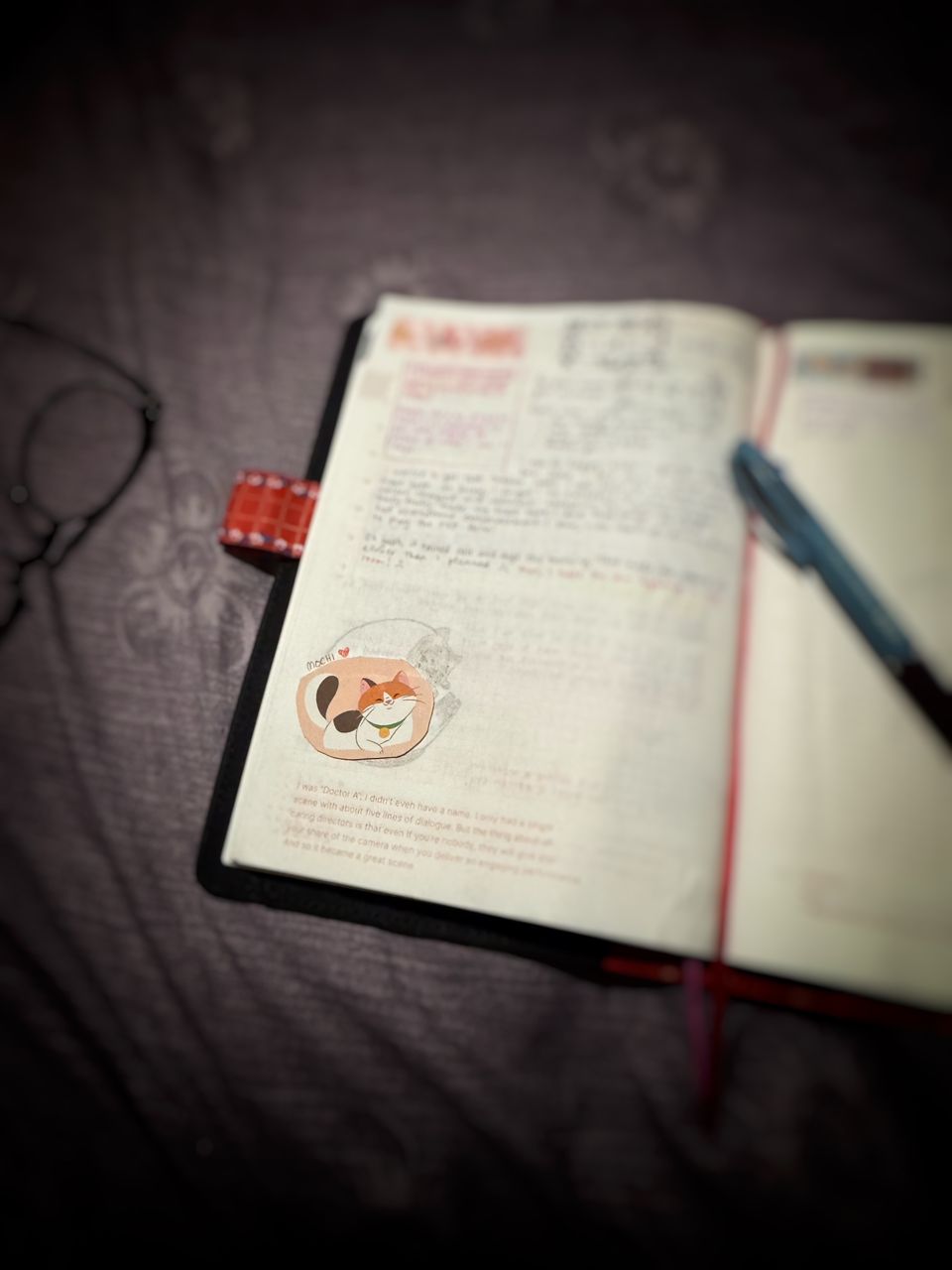
In my first 2026 entry, I said I did not want to keep resolutions, but I did start something new. I started journaling. When I was in Japan, my sisters and I went to Tobichi in Kyoto and purchased my first Hobonichi – A Hobonichi Cousin.

When I first started on the first of January, I thought that it was too plain. And I discussed it with my sister, and she assured me that things will gradually ‘improve’ over time. So, I started doing what I haven’t done in a very long time: writing by hand.

It is my 11th day of journaling, and I realised that I am starting to get the hang of it. I started with prompts from the journaling Facebook pages and began adding more than just words to my journal! I will try to update on how far my journal has gone.

Slowly but assuredly, right?

My Day 11 Entry

I started buying washi tapes, stickers and other journaling tools for my journaling needs, INCLUDING A HOBONICHI STAPPO to carry my stationery, stickers and tapes with me. And it is making a monster out of me.

The Tamagochi Stappo. PHOTO: HOBONICHI (www.1101.com)

Yesterday, when the Jutology Girls came over for our annual gift exchange, I received a present from Della, who gave me the thing I NEARLY BOUGHT for myself after my Japan trip: the Disney Cats Ace Bottle Mega (Mochi) Montigo Tumbler, with my handle engraved on it.

So, I am grateful! Luckily, I did not buy the tumbler.

However, I just started playing Ghost of Yōtei, and after installing the game on my PS5, I started tearing!

Why did I cry?

I started crying because I saw Mount Yōtei. Mount Yōtei looks exactly like her sister, Fujisan. It brought back the moment when I first saw Mount Fuji and started crying because she was so beautiful. That was when I realised I left my heart in Shizuoka with Fujisan.

About the game, I love it so far. It is way better than Assassin’s Creed: Shadows. Don’t get me wrong, I love the franchise, but AC: Shadows is, too, all-over-the-place, for me. They tried doing what they did with Syndicate, but to me, it didn’t work as well.

I will write more about what I think about Ghost of Yōtei once I finish it.

Anyway, I am going to stop here for now. I need to continue with work, and reward myself with gaming afterwards. Heee.

Let’s Try Something Different

MOOD: Almost Creative. ALMOST.
CURRENT MUSIC: Bidadari (The Patriots)
WEATHER: Rain. Thunder. I think, no lightning.
LOCATION: The Hotel
TRIGGER WARNING: Maybe.

I have been taking a liking to these prompts I found on TikTok.

You are a writer;

  1. Where the main character has a mental breakdown. And finally loses it after everything they had to go through… What would the lines be?
  2. Where the main character is fading away after being defeated… What would the lines be?
  3. Where your main character was the hero in the beginning but ended up becoming a villain at the end… What would be the first and the last lines?
  4. How would you write ‘I’m sorry’ without saying the words ‘I’m sorry’?

[ NUMBER ONE ]
“Oh God. Why? Why me? Why do You punish me like this? I may have won the battle, but at the price of losing everything, I hold dear! Why punish me with a fate so cruel such as this? Where did I go wrong? I tried… I nearly died trying, but… why is this the price I have to pay after going to Hell and back. Am I not meant to be happy?” MC wailed, tears flowing down their face furiously as they punched the ground till their knuckles bled.

[ NUMBER TWO ]
MC had always thought death was seeing flashes of their memories as they flew towards a bright, beautiful light, but they were wrong. They lay helplessly as they felt their body feel heavy, and the world turned dark until it was pitch black.

[ NUMBER THREE ]
< first lines > “I decided to start a diary to document my journey to be a hero. I aspire to be the hero people will sing songs about for centuries. I want my legacy to be left on for doing righteous things and vanquishing wrongdoers. I want children to pretend they are me fighting against evil! So, let’s do this!” MC scribbled in their diary whilst feeling determined to help those around them.
< last lines > “The story’s beginning is always full of hope and I wanted to be a hero. All your intentions were right. Your mind is like a white sheet waiting to be coloured, but you meet those who betray you along the way. Resentment is born out of that; soon, the white sheet is painted but not with colours. Rather, it becomes a stain, and then it becomes grey. Eventually, it becomes black with a mixture of red. I had never intended to be a villain until I saw how ugly the world truly is, and felt how painful each strike of betrayal. We were not born to be villains; we are made. This may be my last entry, it may not be, but let this diary be the witness on how a person who wanted to become a hero ended up being a villain,” MC wrote in the last page of their diary.

[ NUMBER FOUR ]
“If I could undo every past mistakes towards you, I would; so this guilt won’t forever haunt me.”

I think it was good exercise for my brain. I miss writing fiction, to be honest, and I have not been writing fiction since the end of 2021. Lately, when I did my training at a local newspaper company, I have been doing a lot of writing but most of those writings were factual and based on interviews and facts.

Maybe, I should start writing again. Although, I wish I had the confidence to do a podcast. Oh well, we will see.

Longings

MOOD: Sleepy, but I am ALWAYS sleepy
CURRENT MUSIC: My PS5 Login Page Music Background
WEATHER: SUPER HOT.
LOCATION: Kuching

I come from a close-knit family – no doubt, I had busy parents growing up, but they ALWAYS made time for us. My sisters and I grew up with old people around us, and we are more or less 10 years apart. Yes, it seemed like planning, but it was not, with miscarriages in between us, and even if my two other siblings had made it, I would always be the middle child. But I wonder if things would have been different if my two siblings had made it. 

Then, I started going into a phase where I started rebelling and had a mind of my own. I felt forced to be seen with my family while other friends were talking about going out with other friends. They had the freedom I yearned for. I will be truthful: I was envious of them because they had said freedom. While friends were hanging out with their friends at Tun Jugah, I was at home with my family doing what my parents enjoyed, going on long drives and spending time with each other. I tried going out once or twice, with permission, of course, and the questions I got from my late mother were like a policeman interrogating his suspect. I did not like it because it felt so. I felt suffocated, and my privacy was breached. To be fair, my parents had to send me out as I did not have a driving license.

In the early 2010s, I left Kuching to continue studying at a college in Kuala Lumpur. That was when I had unlimited freedom. My best friend from school was also with me, and we lived together, so we covered for each other. I had the opportunity to sit at the mamak from dusk to dawn, went out karaoke-ing, and even tried clubbing, which I hated. I even stayed in towns outside Kuala Lumpur – for fun and college activities. However, when I knew my parents were in Kuala Lumpur, I became “well-behaved”. After dinners with family, I would go home, change and go out again to hang out at the mamak with friends. However, there were days when I would decide to stay at my parents’ place because I missed them. 

But by then, I had started working at the motorcycle company I had worked part-time with after Form 5 before enrolling in my Sixth Form. Because of my involvement with events, I got involved with social activities again but appreciated my time at home despite the overtime and the outside activities. This was also when I started getting closer to my mother, telling her what I had been up to and explaining why I had to go out at certain hours. This was also when I started keeping to my curfew. 

It was during the peak of COVID-19 when my mother had her first bad fall. When she fell, we rushed her to the hospital, and she was admitted. It was October 2020; funnily, I remember this because my social life was mostly through online mobile gaming. The whole time my mother was admitted, I was on my phone, and she kept asking me what I was doing, staring at my phone and sniggering to myself. So, I told her I had befriended some people older than me from places like the US, Sweden, Bulgaria, and more! I started updating her on the news from those parts of the world, and I must say that they were great because they were supportive of me and my elder sister, who was also playing the game when my beloved aunt, who was like a second mother to my sisters and me, passed away. I showed my mother what they did in the game, and she was in awe. 

When she was discharged, I went to Kuala Lumpur almost every two weeks for her treatment. I was assigned to escort her everywhere she went, from her treatments in Kuala Lumpur to physiotherapy in the hospital in Kuching. From then on, I got extremely close to my mother. She would ask what I did, and I would tell her. 

I even spoke to her about the guy I was dating, who later became my husband, and she approved of him. Since then, “J, tell Akim I want to eat satay,” and he will get it for her. I will be truthful, and I was afraid when I told her about him. At first, she was not warm towards him, but when she relied on his help, I felt I wished I had told her about him earlier. 

Because of my responsibility to my mother, I started wanting to go out less with friends, and I am glad the small group of friends has understood that. My mother allowed me to have sleepovers with my best friends, Serena and Juliana when Serena would come from Miri to Kuching. Well, thanks to Facebook, she could keep track of our activities. Whenever I came home from a night out with the girls, I would tell her the funny stories we girls shared: the abridged version, mind you. 

Caring for my mother has made me feel happier at home. During this time, my goal in life was to make her smile and laugh. My mother was a strict woman who was not easy to joke around with, but it was her fate to have a happy-go-lucky daughter like me! Whenever she laughed at my jokes, it just made me happy. Although, there were times I got caught by surprise when she turned around and added to my jokes. Half the time when she does, I get a bit dumbstruck, but those were happy times. However, by this time, my mother was already getting frail, but let me be clear: that woman has the will of steel. That is the thing about my mother: she was a very strong woman. 

Then, my mother fell again on the second day of Hari Raya Aidilfitri 2022. This time, I was guilt-ridden because this was the second time she fell on my watch. What made it worse was that I did not know she fell until she called for my name, and I turned to find her on the floor. Once again, we brought her to the hospital, and the outcome was less optimistic than the first. I did not want to think the worst of the situation. 

“It was going to be okay,” I kept telling myself. “Mummy is going to get discharged as soon as it gets okay!” 

Then things turn for the worse. I started getting depressed, maybe from the lack of sleep at night in the hospital, maybe from worrying about my mother. I did not know, but I heard these annoying little voices. 

“You were the cause of Mummy’s fall!” the voice said, and it was distinctively my voice, reminding me of the day she fell. It got worse when my mother’s condition deteriorated and became more than just a fall. 

I went home one evening to get food for her after she asked for tempoyak and her favourite salted fish. I remember ordering McDonald’s through Grab, but Grab had an issue with the rider because it was raining heavily. So, she kept calling, asking me where I was. I left the house without waiting.

The first thing she said to me when I walked into her ward was, “I lost my appetite.” 

That broke me. All this while, I happily made her comfortable and proud; hearing those words hurt me so bad I hid in the pantry pretending to prepare her meal, but I ended up calling my younger sister in Kuala Lumpur and begging her to come home. By then, I was tired – physically and mentally. It did not help that those voices in my head started getting louder and louder, blaming me for her fall. Eventually, my younger sister came home on the first flight out the next day after my distressed call. I was told to go home to sleep, and I did. 

A phone call from my younger sister woke me up, telling me that my mother was moved to the High Dependency Unit (HDU) because of her worsening condition, and once again, I got worried. Deep down inside me this time, I knew she was not in a good way. Quite honestly, it was from one thing to another for us all. From always getting a two-way conversation, it was just me talking to my coma-induced mother. It hurt whenever I updated my whereabouts, and she did not respond, but that did not stop me from telling her where I went or what I did. Whenever I left her in the HDU, I touched her hand to tell her I was going home and would be back the next day. 

On the 24th day in the hospital, I was awoken by the home helper (Kakak) at 4 am, saying I was needed at the hospital. I checked my phone and saw missed calls from my elder sister and a WhatsApp message stating she was at the hospital. I called and spoke to my elder sister, and she said that my mother was losing a lot of blood. What I remembered hearing was the Surah Yasin playing loudly in the background. My heart broke, knowing what was happening. When I got to the HDU, the nurse-in-charge told me in Malay that my mother was in critical condition despite her super positive response the day before. Those words, critical (nazak in Malay), stabbed me, and there my mother was on the bed with nurses tending to her, looking like an angry wet cat. Mean as it sounds, that was how it was. 

I was speechless. I was feeling empty. No words left my lips at that moment. I could not bear the sight of my mother, who was in pain and probably annoyed that people were fussing over her. When the doctor-in-charge asked us if she wanted to video call my father, we asked her, and she said she wanted to wait for him to come home. Luckily, my father could charter a flight home with my younger sister. I had a brief moment when I was alone with her when I asked her if she was proud of me and what I had done for her. She nodded. Immediately, all the self-inflicted guilt disappeared. All I needed was just that from her. 

My father arrived by 9 something that morning, if I am not mistaken, and the doctor took my mother off life support by 11 am. My mother fought a fierce fight until 6.27 pm when she drew her last breath. It was on the 27th of May 2022, the 26th day of Syawal, and it was still a Friday based on Muslim timing. For those who do not know, a new day starts at Maghrib. 

It felt empty, although I did not have to go to the hospital anymore. I felt lost because I did not have to hear my mother nagging at or interrogating me. I suppose the words: “You will know you miss someone most when they are gone” ring true. I did not like it. I was used to having my mother siccing on me, and now I am older and probably wiser; I appreciated all she did. 

Today, after a year and eight months, I thank God my mother was the way she was with my sisters and me. I am glad she brought us up the way she did. When I lost my mother, it felt like I did not spend enough time with her, but many people have told me that I would have been the most satisfied because I spent the most time with her. But they do not know I was unhappy with that short period spent with her. Time was cruel, and maybe, in a small way, I was cruel, too. I was so busy trying hard to break free from my family’s “close knits”, but none of us was getting any younger. Now that I am older, I appreciate every memory I have with them.

After I lost my mother, I made a small promise to myself that I would spend more time with my father at every opportunity I had, and that is what I am doing now, even though I have the loveliest stepmother on the face of the Earth to take care of him, but to time spent with them is more precious. 

“If I had a flower for every time I thought of you… I could walk in my own garden forever.” – Alfred Lord Tennyson, English Poet.